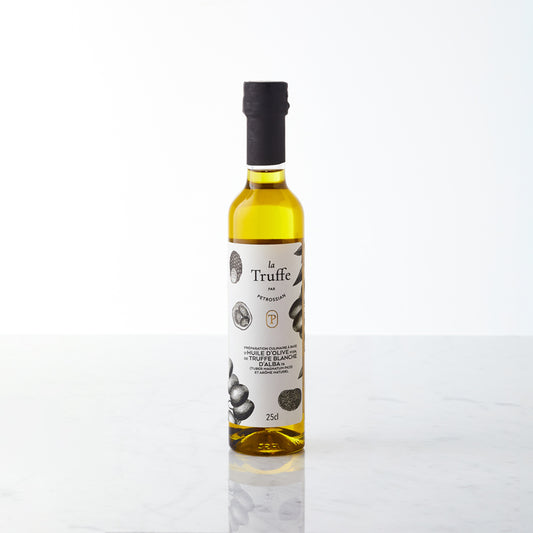
Truffle oils and seasonings will add a savoury, aromatic note to all your dishes. You can use them to prepare sauces, dressings, or as a finishing touch.
Read more
Recipes
 
Gaufres au caviar et œufs de poisson

Waffles with Caviar and Fish Roe

For a gourmet and festive appetizer, make savory waffles and top them with caviar, fish roe, and cream. The richness of the waffles combined with the briny notes of the fish roe and the creaminess of the cream creates a deliciously indulgent mix that everyone will enjoy.

45 min

Easy

6 pers.

Read more
 
Tartelettes gastronomiques au caviar

Gourmet Caviar Tartlets

Discover our fantastic recipe for gourmet caviar tartlets, enhanced with a hint of lemony flavor from Oxalis leaves…

1h

Easy

5 pers.

Read more
 
Saint jacques au caviar

Scallop Carpaccio, Caviar and Lime Cream

Discover the easy and delicious recipe for scallop carpaccio with caviar and lime by Petrossian, and all the ingredients to elevate it…

45 min

Moyen

4 pers.

Read more

Frequently Asked Questions (FAQ)

What is the difference between whole truffle and truffle pieces?

The difference between whole truffle and truffle pieces mainly lies in appearance, grading, and culinary use, as well as the level of refinement of the product.

A whole truffle is an intact mushroom, harvested and selected in its most noble form. It is sorted according to size, regularity, and visual quality. This is the most prestigious presentation: it is sliced, shaved, or grated directly over dishes, especially as a finishing touch, in order to preserve the full complexity of its aromas.

Truffle pieces are made from broken truffles or fragments obtained during sorting or cutting. Although less visually appealing, they retain most of the truffle’s flavor qualities and are a more affordable alternative. They are particularly suited for culinary preparations such as sauces, stuffings, risottos, or scrambled eggs, where truffle is incorporated into the recipe rather than presented as visible slices.

In short, whole truffle is preferred for fine finishing and exceptional dishes, while truffle pieces are ideal for flavoring and incorporating truffle into everyday or hot preparations.

What is the difference between fresh truffle and preserved truffle?

The difference between fresh truffle and preserved truffle mainly lies in the preservation process and its impact on texture and aroma.

Preserved truffle undergoes sterilization (appertization) at high temperature. This process alters its structure: the texture becomes softer and less firm, and its aromatic profile shifts toward earthier and less volatile notes. In return, it offers excellent shelf stability, with a storage life of 2 to 3 years at room temperature.

Fresh truffle, on the other hand, is a living and fragile product. It must be consumed quickly, usually within 7 to 10 days when refrigerated, in order to preserve the full richness of its aromas. It is best used as a finishing touch, shaved or thinly sliced over a hot dish just before serving, to fully release its fragrance.

Preserved truffle is used differently: it is generally chopped or incorporated during gentle cooking, then infused into hot preparations. It is not eaten raw, but its juice can be particularly useful to enhance risotto, deglaze meat, or flavor sauces.

To ensure good quality in preserved truffle, it is recommended to check the ingredients list: a short list is a sign of purity, ideally limited to truffle (Tuber melanosporum), water, and salt, or a neutral oil base. The mention of natural truffle aroma can also indicate a properly made product without excessive additives.

Which truffle should you choose for a hot dish?

For hot cooking, the reference truffle is the black truffle (Tuber melanosporum), considered the ultimate gastronomic truffle. It is the only variety that can truly withstand cooking without losing its aromatic identity, provided it is handled with care.

Indeed, black truffle reveals its full potential when combined with gentle heat and a fatty base such as butter, cream, eggs, or oil. These fats act as aroma carriers and release its deep notes—earthy, woody, and slightly animalic—characteristic of great culinary dishes.

In contrast, more delicate truffles such as white truffle (Tuber magnatum) must always be consumed raw, as heat quickly destroys their aroma.

For hot dishes, black truffle is therefore the ideal choice: it brings power, complexity, and elegance while enhancing simple preparations such as scrambled eggs, fresh pasta, or creamy sauces.

Truffle Oil | Petrossian

Discover our delicious truffle oils (white, black, summer) and our truffle seasonings: balsamic vinegar, mustard, salt… Free 24h delivery.