Free delivery on orders over CHF 150
Secure card payment
Our suggestions
Tuber melanosporum 1%
Black Truffle Almonds (Tuber melanosporum, 1%)
Whole lightly-cooked Goose Foie Gras
Purely traditional, lightly-cooked foie gras
Our suggestions
Tuber melanosporum 1%
Black Truffle Almonds (Tuber melanosporum, 1%)
Whole lightly-cooked Goose Foie Gras
Purely traditional, lightly-cooked foie gras
Black Truffle Fleur de Sel (Tuber melanosporum, 2%)
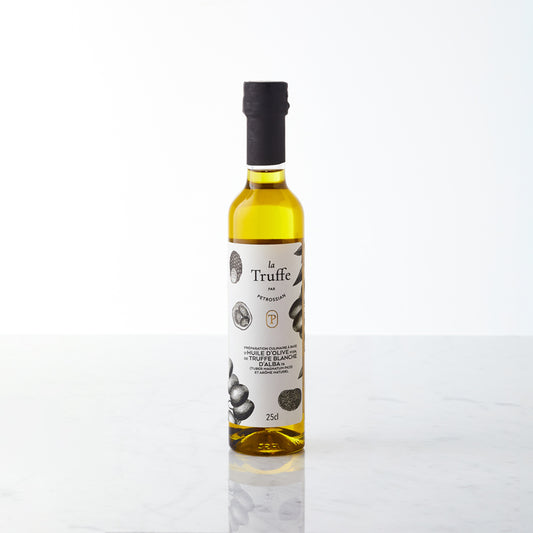
97.8% olive oil with 1% white truffle (Tuber magnatum pico) and flavouring
The subtle aroma of black truffles combined with the power of mustard
Summer Truffle Ketchup (Tuber aestivum vitt, 5%)
A refined vinegar flavoured with truffle
Summer Truffle Honey (Tuber aestivum vitt, 3%)
The essential trio for dressing
The subtle combination of soy sauce and truffle
Olive oil with 3% white truffle (Tuber aestivum vitt) and natural flavouring
A liquid truffle concentrate
98% extra virgin olive oil with 1% black truffle extract (Tuber melanosporum) and natural flavouring
Tuber melanosporum 5%
Our Recipe Ideas
98% extra virgin olive oil with 1% white truffle extract (Tuber magnatum pico) and flavouring
Tuber melanosporum 1,5%
Tuber melanosporum 5%
Parmesan shortbreads with truffle pesto cream
40 min
Medium
6 pers.
Cherry Tomato and Truffle Tarte Tatin
1h
Easy
4 pers.
Pumpkin Velouté with Porcini and Truffle
25 min
Easy
4 pers.
The difference between whole truffle and truffle pieces mainly lies in appearance, grading, and culinary use, as well as the level of refinement of the product.
A whole truffle is an intact mushroom, harvested and selected in its most noble form. It is sorted according to size, regularity, and visual quality. This is the most prestigious presentation: it is sliced, shaved, or grated directly over dishes, especially as a finishing touch, in order to preserve the full complexity of its aromas.
Truffle pieces are made from broken truffles or fragments obtained during sorting or cutting. Although less visually appealing, they retain most of the truffle’s flavor qualities and are a more affordable alternative. They are particularly suited for culinary preparations such as sauces, stuffings, risottos, or scrambled eggs, where truffle is incorporated into the recipe rather than presented as visible slices.
In short, whole truffle is preferred for fine finishing and exceptional dishes, while truffle pieces are ideal for flavoring and incorporating truffle into everyday or hot preparations.
The difference between fresh truffle and preserved truffle mainly lies in the preservation process and its impact on texture and aroma.
Preserved truffle undergoes sterilization (appertization) at high temperature. This process alters its structure: the texture becomes softer and less firm, and its aromatic profile shifts toward earthier and less volatile notes. In return, it offers excellent shelf stability, with a storage life of 2 to 3 years at room temperature.
Fresh truffle, on the other hand, is a living and fragile product. It must be consumed quickly, usually within 7 to 10 days when refrigerated, in order to preserve the full richness of its aromas. It is best used as a finishing touch, shaved or thinly sliced over a hot dish just before serving, to fully release its fragrance.
Preserved truffle is used differently: it is generally chopped or incorporated during gentle cooking, then infused into hot preparations. It is not eaten raw, but its juice can be particularly useful to enhance risotto, deglaze meat, or flavor sauces.
To ensure good quality in preserved truffle, it is recommended to check the ingredients list: a short list is a sign of purity, ideally limited to truffle (Tuber melanosporum), water, and salt, or a neutral oil base. The mention of natural truffle aroma can also indicate a properly made product without excessive additives.
For hot cooking, the reference truffle is the black truffle (Tuber melanosporum), considered the ultimate gastronomic truffle. It is the only variety that can truly withstand cooking without losing its aromatic identity, provided it is handled with care.
Indeed, black truffle reveals its full potential when combined with gentle heat and a fatty base such as butter, cream, eggs, or oil. These fats act as aroma carriers and release its deep notes—earthy, woody, and slightly animalic—characteristic of great culinary dishes.
In contrast, more delicate truffles such as white truffle (Tuber magnatum) must always be consumed raw, as heat quickly destroys their aroma.
For hot dishes, black truffle is therefore the ideal choice: it brings power, complexity, and elegance while enhancing simple preparations such as scrambled eggs, fresh pasta, or creamy sauces.
The true truffle experience is, above all, seasonal. Fresh truffles are only available during their harvest period, which varies depending on the species.
Outside the season, however, you can still enjoy their flavour through several high-quality alternatives:
There is also the summer truffle (Tuber aestivum), harvested between May and August. Milder in flavour than the Périgord black truffle (Tuber melanosporum) or the Alba white truffle (Tuber magnatum), it is an excellent introduction to truffles at a more affordable price.
It all depends on the dish and the role the truffle plays.
If truffle is the main ingredient (such as in scrambled eggs, risotto, pasta, or mashed potatoes), allow 15 to 20 g of fresh truffle per person.
If it is simply used to flavour a recipe or shaved over the dish just before serving, 5 to 10 g per person is more than enough. As an example, 5 g of high-quality Melanosporum black truffle is already enough to give a simple dish an intense truffle aroma.
Our advice: it is better to use a small amount of genuine fresh truffle than a large quantity of lower-quality truffle products.
Yes. Gourmet truffle gift sets are especially popular during the holiday season or as a gourmet gift.
They typically include:
You can find these gift sets in delicatessens and from specialist houses such as Petrossian.
When choosing a gift set, take a close look at the ingredient list: many "truffle" oils and salts are mainly flavoured. Choose products that clearly state the presence of real truffle (or truffle extract) in their ingredients.
To buy truffles online with confidence, a few criteria can help identify a reliable seller:
Well-established specialist houses such as Petrossian provide additional reassurance thanks to their rigorous selection process and expertise in maintaining the cold chain.
The essentials
To enjoy the signature flavours of truffle, a few products are true classics: high-quality truffle oil, truffle pieces, truffle cream, truffle butter, and truffle salt. They are perfect for elevating fresh pasta, scrambled eggs, homemade mashed potatoes, or risotto with minimal effort.
The more original options
To surprise your guests, try more unexpected creations such as truffle tarama, truffle-flavoured almonds, truffle honey served with aged cheeses, or gourmet savoury biscuits for aperitifs. These specialties add an elegant touch to festive meals and offer a different way to experience truffle.
The Alba white truffle (Tuber magnatum) is widely regarded as the ultimate choice for pasta. Its exceptionally intense, complex, and slightly garlicky aroma is best enjoyed when freshly shaved or sliced into thin pieces over hot pasta. It should never be cooked—the heat of the dish alone is enough to release all of its aromas.
The Périgord black truffle (Tuber melanosporum) is also an excellent choice. More accessible, it pairs perfectly with buttered tagliatelle, light cream sauces, or Parmesan. It is best used freshly grated or in fine pieces just before serving.
Among the most popular recipes, several classics showcase the delicate flavours of truffle perfectly:
These recipes allow you to enjoy the full flavour of truffle without overpowering its delicate aroma.
For the best-quality truffles, consider:
The most important thing is to know exactly which truffle species you are buying and where it comes from.
Contrary to popular belief, most truffle oils available on the market are not simply infused with fresh truffles. They generally use a natural or food-grade flavouring, sometimes combined with small pieces of truffle.
To choose a high-quality truffle oil, look for:
Some gourmet houses, such as Petrossian, offer oils containing genuine fresh truffle, providing a richer and more authentic aromatic profile.
The Tuber melanosporum, also known as the Périgord black truffle, is considered the benchmark among black truffles.
It is prized for its powerful, complex, and long-lasting aroma, its black flesh marbled with fine white veins, and its great versatility in cooking. It can be enjoyed raw, shaved over a hot dish, or used in gentle cooking preparations.
The finest productions come mainly from Périgord, the Vaucluse region, as well as certain areas of Spain and Italy.
When buying, choose a truffle harvested at full maturity, firm to the touch, intensely fragrant, and with its Latin name clearly stated. By contrast, Chinese truffles (Tuber indicum), which are far less aromatic, may sometimes be offered at lower prices, so it is essential to check the species.
There is no universal answer—it all depends on how you intend to use it.
The Alba white truffle (Tuber magnatum) is often considered the most prestigious truffle in the world. Its exceptional aroma, both intense, complex, and slightly garlicky, is enjoyed exclusively raw.
The Périgord black truffle (Tuber melanosporum) is more versatile. It can withstand gentle cooking, works with a wide range of recipes, and offers excellent value for money.
In practice:
While white truffle offers the most spectacular aromatic experience, black truffle remains the more accessible and easier-to-cook choice.
Black truffle pairs beautifully with complex, elegant, and slightly aged wines.
Classic pairings include:
The goal is to complement the truffle’s earthy, woodland aromas without overpowering them.
The price varies depending on the species, season, and quality.
On average:
Based on weight, a black truffle priced at €1,000/kg represents around €1 per gram. A serving of 10 to 20 g therefore costs approximately €10 to €20 per person for an exceptional dish.
The best sauce is often… no sauce at all. Truffle should remain the star of the dish.
The most classic pairing is to coat the pasta with a brown butter sauce made from high-quality butter, then add a little finely grated Parmesan before shaving fresh truffle over the dish off the heat.
Another excellent option is a light cream sauce, gently reduced and enriched with a small amount of butter. The truffle should always be added at the very last moment to preserve all its aromas.
On the other hand, it is best to avoid garlic, onion, or shallot, as their powerful flavours would mask the delicacy of the truffle.
Discover our delicious truffle oils (white, black, summer) and our truffle seasonings: balsamic vinegar, mustard, salt… Free 24h delivery.
Receive our invitations, recipes, news, and new products
Free delivery on orders over €150
Cold chain guaranteed. Choose your delivery slot
Need expert advice?
A question? Need advice?
Contact a Petrossian expert
The art of giving
Signature packaging
and personalized message
Secure payment
Visa, Mastercard, Amex, Paypal, and installment payments with Alma